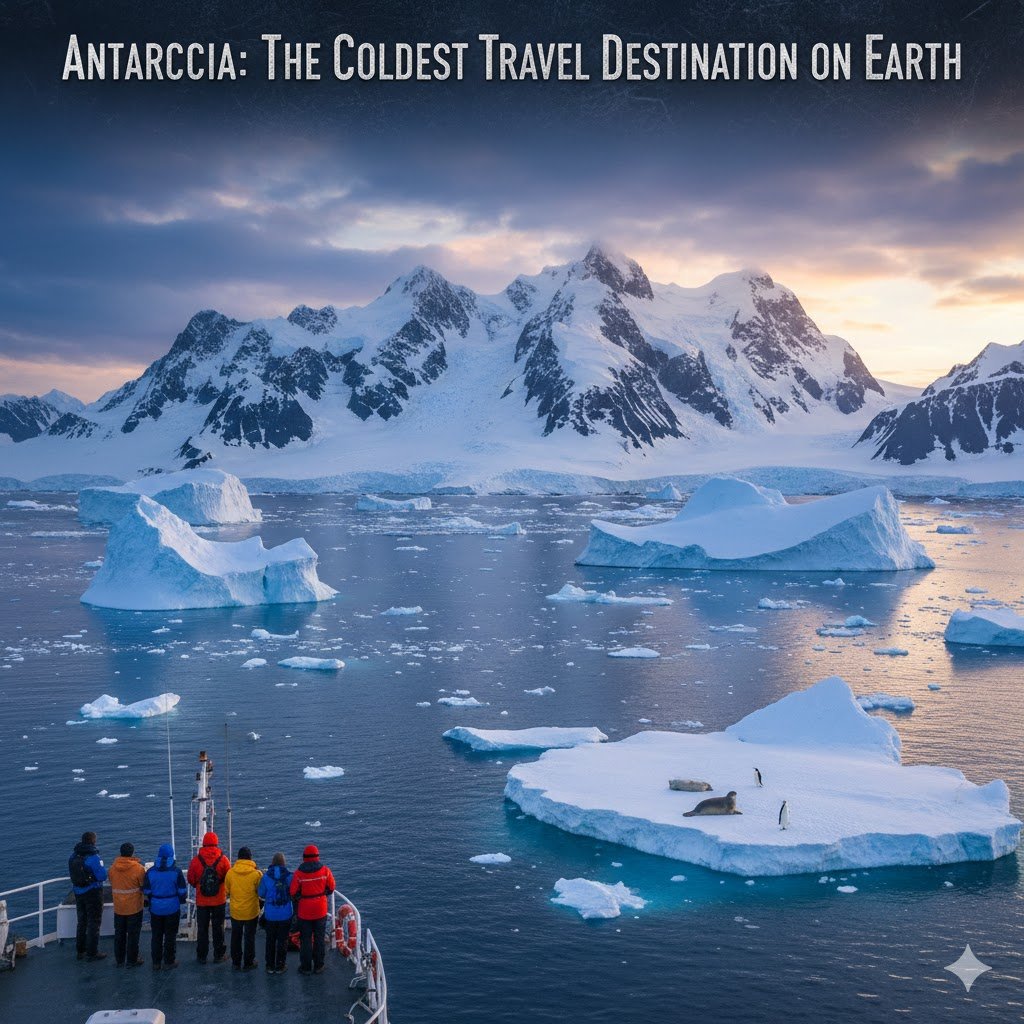
At the bottom of the planet lies a frozen world unlike any other — Antarctica. Covered almost entirely by ice and surrounded by powerful oceans, Antarctica is the coldest, driest, and windiest continent on Earth. Despite its extreme environment, it has become one of the most unique travel destinations for adventurous explorers.
A Land of Ice and Extremes
Antarctica holds nearly 90 percent of the world’s ice and around 70 percent of its fresh water. Temperatures during winter can fall below −80°C, making survival extremely difficult without specialized equipment.
Unlike other continents, Antarctica has no permanent cities or native human population. Only scientists and researchers stay temporarily at research stations to study climate, wildlife, and Earth’s environmental systems.
How People Travel to Antarctica
Reaching Antarctica is not easy. Most travelers begin their journey from Ushuaia, often called the southernmost city in the world. Expedition ships cross the dangerous Drake Passage, known for powerful waves and unpredictable weather.
The journey itself is considered part of the adventure, as travelers experience one of the roughest seas on the planet before arriving at icy landscapes.
Wildlife in a Frozen World
Despite extreme cold, Antarctica is full of life. The continent is famous for large colonies of penguins, including emperor and gentoo penguins. Seals rest on floating ice, while whales migrate through surrounding waters searching for food.
These animals survive through incredible adaptation, relying on thick layers of fat, dense feathers, and social behavior to withstand freezing conditions.
A Paradise for Scientists
Antarctica plays a major role in global scientific research. Ice cores collected from deep beneath the surface help scientists study Earth’s climate history going back hundreds of thousands of years.
Research stations operated by different countries monitor climate change, atmospheric conditions, and marine ecosystems. Because the environment is relatively untouched, it provides valuable information about natural processes.
Strict Environmental Protection
Tourism in Antarctica is carefully controlled under international agreements. Visitors must follow strict environmental rules to prevent pollution and protect wildlife habitats.
Ships limit passenger numbers, and travelers must maintain distance from animals. Even small actions, such as leaving waste behind, are strictly prohibited.
Why Travelers Dream of Visiting
Antarctica offers landscapes unlike anywhere else on Earth. Massive glaciers, floating icebergs, and endless white horizons create a feeling of complete isolation.
Many travelers describe visiting Antarctica as life-changing. The silence, clean air, and untouched nature provide a rare opportunity to experience the planet in its purest form.
Challenges and Risks
Traveling to Antarctica requires preparation and significant expense. Weather conditions can change rapidly, and temperatures remain dangerously low even during summer months.
Medical facilities are limited, and evacuation during emergencies can be difficult. For this reason, only guided expeditions are allowed.
The Future of Antarctica
Scientists closely watch Antarctica because melting ice sheets could affect global sea levels. Changes in this region may influence weather patterns around the world, making it one of the most important places for climate research.
Protecting Antarctica is considered essential for the future of the planet.
Conclusion
Antarctica is more than just the coldest destination on Earth — it is a symbol of nature’s power and beauty. From massive ice landscapes to extraordinary wildlife, the continent offers an unforgettable experience for those brave enough to visit.
In a world filled with crowded cities and modern technology, Antarctica remains one of the last truly wild places, reminding humanity how vast and untouched our planet can still be.